Are you working as a babysitter or planning to start? This guide covers the updated 2026 rates Denmark, the average hourly pay, and practical examples to help you calculate how much to charge based on your experience, location, and work schedule.
Have you found a part-time babysitting job but aren’t sure how much to charge? Or are you already working as a babysitter and want to know if your hourly rate is fair? In Denmark, the average babysitting rate in 2026 is around DKK 60 per hour, according to the latest childcare data. This rate typically covers young people under 18 who provide informal care in their free time or in the evenings.
But that’s just an average. The actual hourly rate can vary considerably, from under 50 DKK to over 100 DKK per hour, depending on age, experience, and the scope of the tasks. Pay can also increase if you look after multiple children, work weekends, or help with homework and cooking.
In this guide, you’ll find everything you need to understand how much you can expect to earn as a babysitter, how to work out your own hourly rate, and when you can reasonably ask for more.
How much does a babysitter get per hour?
As mentioned, the average hourly rate for childcare in 2026 is around DKK 60, according to data from Sitly. This is just an average though, and your rate may be higher or lower depending on where you work, your experience, age, how many children you look after, the time of day, and the type of arrangement you have with the family.
If you work regularly for one family and are responsible for young children, cooking, or school pick-ups, you probably have a contract, and your hourly rate typically falls between 80 and 120 kr., with the wage reported to SKAT. If you’re a teenager or student who only looks after children occasionally, for example in the evenings, without a permanent contract, you can expect to earn around 50–70 kr. per hour.
To give you a concrete starting point, we’ve put together an overview of average babysitting rates in Denmark in 2026, based on profiles on Sitly.dk. The figures reflect the rates babysitters themselves list.
| Age/type | Indicative hourly wage (DKK) |
|---|---|
| Under 16 years | 50–70 |
| 16–18 years | 60–90 |
| 18–20 years | 80–120 |
| 20–25 years | 100–140 |
| Over 25 years | 130–160+ |
These figures give you a realistic picture of what you can expect to earn in a part-time babysitting job in 2026, depending on your age and responsibilities.
Example: babysitter, 18 years old, 3 children, cooks dinner
Sarah is 18 and has extensive experience in childcare. She’s just started a teacher training course and holds a child first aid certificate. She looks after three children, aged 8, 5, and 3, once a week. She arrives at 2:00 PM, picks up the two oldest along with the youngest, and takes them all home for snacks and play. If the weather’s good, she cycles with them to a nearby farm on the family cargo bike. The parents also appreciate that she makes dinner, so they can all eat together once they’re home around 5:30 PM.
What’s a fair rate for Sarah?
- 70 DKK/h (typical minimum for an 18-year-old babysitter)
- +30 DKK/h (for two extra children)
- +10 DKK/h (for experience and the first aid course)
= 110 DKK/hour
Total payment: 110 kr. × 3.5 hours = 385 kr. Since Sarah also cooks dinner, the family decides to round it up to a fixed 400 kr.
Babysitting rates in Denmark’s largest cities
The rates listed by babysitters registered on Sitly can help you work out your own hourly rate, since they give a good sense of what’s considered fair for your kind of work. That said, the actual rate is always agreed between you and the family, and depends on several factors.
One of the most important is where you work. Babysitting rates can vary quite a bit from city to city. For example, babysitters in Copenhagen usually earn a little more than in smaller cities like Odense or Aalborg, but it all comes down to the nature of the tasks and your experience. If you live in a smaller city and look after two young children, or have several years of experience, you could easily earn more than someone just starting out in the capital.
Data from 2026 shows that babysitters in Copenhagen charge an average of between DKK 90 and DKK 120 per hour, while rates in other cities tend to be a bit lower. These figures give you a solid basis for setting your own rate, whether you’re looking for part-time babysitting work or working full-time for a family.
Infographic: how much does a babysitter earn in Denmark?
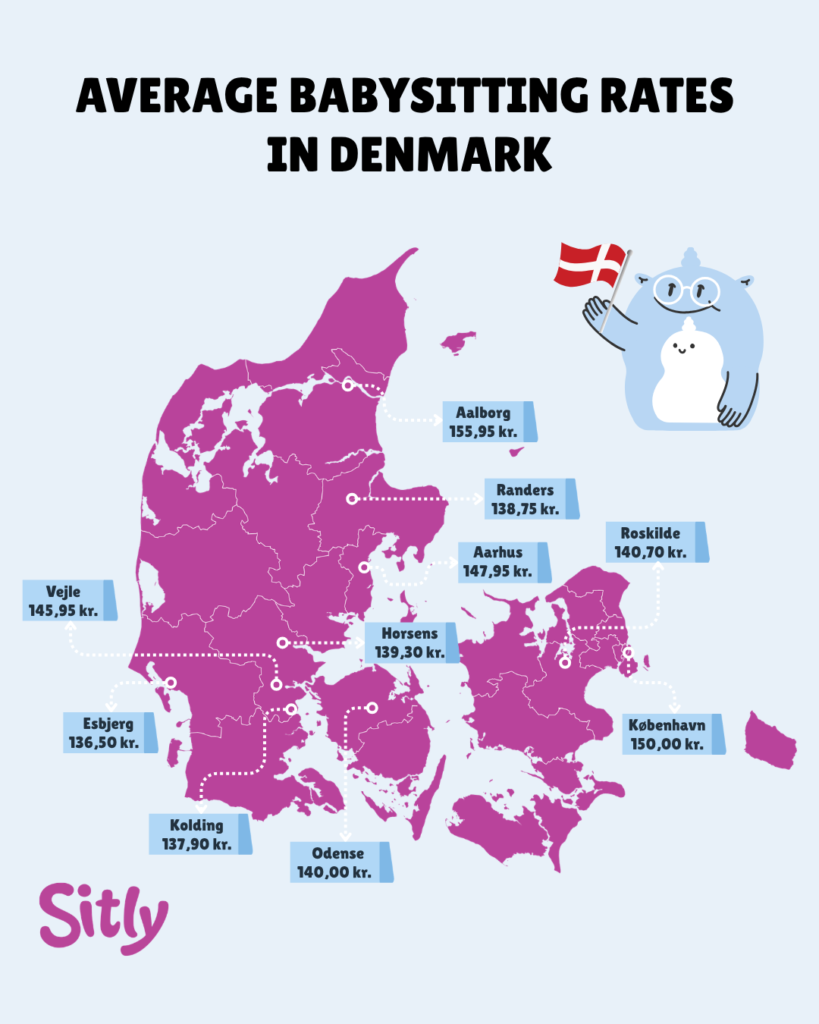
The figures are based on the average hourly rates listed in the profiles of 13,800 babysitters on Sitly.
Calculate your babysitting rate
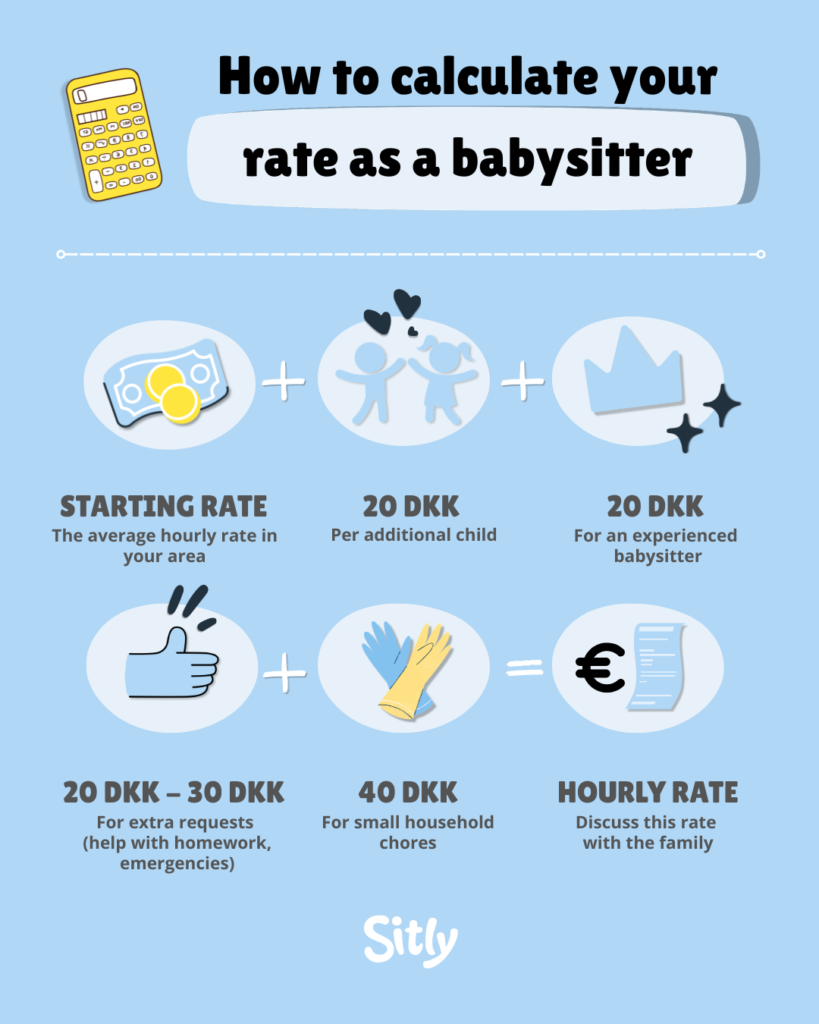
Beyond where you work, several other factors can push up your rate as a babysitter: your experience, your qualifications, how many children you look after, and any extra tasks you take on for the family. All of these affect your final hourly rate. The infographic below will help you work out your own rate based on the work you do for the family.
Try the Sitly calculator to instantly see babysitting rates in your area. Just enter your city, the babysitter’s duties, and the number of children, and get an average rate right away.
Infographic: babysitting rate calculation
How much does an experienced, qualified babysitter earn?
If you have several years of experience with children, or a relevant qualification, for example as a teaching assistant, childminder, or social and health care assistant, you can expect to earn more than the standard rates. Families are happy to pay extra when they see professionalism, reliability, and pedagogical skills.
Hourly rate for babysitters looking after two children
When you’re looking after two or more children, your hourly rate can go up by around 10–20% compared to the standard rate, depending on how demanding the work is. Looking after two younger siblings, for instance, takes more attention and energy than looking after one older child. If the children are quite different ages, it can also be harder to find activities that suit both.
Babysitting rate with light household chores
Tidying the children’s room, preparing their meals, washing up, or folding their clothes are often part of a babysitter’s normal duties. But if you’re asked to take on small household chores for the whole family, like hanging laundry, dusting, or vacuuming, that counts as extra work and should be paid separately.
Rate when using your own car
Many babysitters pick children up from school, take them to after-school activities, and drive them home again. If you use your own car for this, you can agree with the family on a fixed weekly or monthly allowance to cover petrol and wear and tear.
Babysitting rates in the evening and at night
Evening care is usually paid a little better, since the hours are less convenient. As a rule of thumb, you can ask for 10–20% more than your regular daytime rate. For example, if you normally earn 100 kr. per hour, you could ask for 110–120 kr. for evening work, especially if you stay overnight or work past 10 PM.
That said, the rate also depends on the nature of the work. If you arrive once the children have already eaten and are about to go to bed, it’s reasonable to accept a slightly lower rate. But if you’re looking after young children who wake up often, or need to be ready to help during the night, it’s fair to ask for more.
A good tip: agree in advance with the family how your safety at night will be handled. Will they walk you home? Cover a taxi? Make sure you get to your car safely? Your safety should always come first, and it should be something you and the family agree on together.
Example: babysitter, 16 years old, 2 children, evening care
Lieke is 16 and in high school. She has over two years of regular experience looking after her younger brother and cousins. In her new babysitting family, she occasionally looks after two children on weekend evenings. When she arrives at 7:30 PM, the children are already asleep. She stays until 11:30 PM, and the parents drive her home afterwards. She’s given snacks and drinks along the way and asked to empty the dishwasher.
What’s a fair rate for Lieke?
- 36 DKK/h (typical minimum for a 16-year-old)
- +10 DKK/h (for responsibility for two children)
= 46 DKK/h
But since the children are already asleep and rarely wake up, Lieke and the parents agree on a fixed rate of 40 DKK/h instead. Total payment: 40 DKK × 4 hours = 160 DKK. Lieke is very happy with this arrangement.
Babysitting pay: hourly rate or fixed monthly salary?
Is it better to be paid by the hour or with a fixed monthly rate? It depends on the kind of work you do for the family. If your hours are sporadic or vary week to week, an hourly rate makes the most sense, since you’re only paid for the time you actually work.
If, on the other hand, you work regularly for one family, a fixed monthly rate can be more practical. In that case, it’s worth defining exactly what the agreement covers. For example: if the family doesn’t need you one day, do you still get paid? If they have an unforeseen need and ask you to stay two extra hours, is that overtime? And what happens in a month with five Tuesdays instead of the usual four?
A good tip: agree on all of this in advance to avoid misunderstandings and keep things professional with the family.
Babysitting rates for urgent, last-minute needs
What if the family calls at the last minute, say, early in the morning because the child is sick? In these cases, it’s reasonable to ask for a higher rate, typically 10–20% more than usual. It’s best to agree on an “emergency rate” in advance, one that applies whenever the family needs you to step in at short notice. That way everything’s clear beforehand, and your flexibility is fairly rewarded.
Example: babysitter, 21 years old, 1 child, afternoon care + lunch
Nanna is 21 and studying to become a teacher. She’s taken a child first aid course and is currently in a period with fewer teaching hours. Every Wednesday afternoon, she looks after a 6-year-old boy for a regular family. She picks him up from school at 12:00, has lunch with him, plays with him, and stays until his parents get home at 6:00 PM. The family provides food and encourages outdoor activities. The boy is very active, so Nanna is engaged the whole time. Small expenses, like bus fare or snacks, are reimbursed.
What’s a fair rate for Nanna?
- 105 DKK/h (typical minimum for babysitters aged 21+)
- +5 DKK/h (for experience and first aid certificate)
- +5 DKK/h (for active care and full attention)
= 115 DKK/h
Total payment: 115 DKK × 6 hours = 690 DKK. The family rounds it up to 700 DKK and provides lunch for Nanna.
How much does a babysitter earn per month?
Monthly income for a babysitter in Denmark can vary a lot depending on hours and experience. Working part-time, around 20 hours a week, you could earn between DKK 4,500 and DKK 6,000 a month, depending on the tasks and time of day. Working full-time, with experience caring for infants or children with special needs, income can exceed DKK 9,000 a month. Babysitters with greater responsibilities, or who live with the family, can earn even more, though these are usually more formal roles with a contract and reported salary.
How much does a babysitter earn per day?
If you’re only working a few days, say during school holidays or while parents are away on business, you can agree on a daily rate instead of an hourly one. The calculation is simple: multiply your hourly rate by the number of hours you work. An eight-hour day typically works out to DKK 1,000–1,200, though it can be higher if you’re looking after young children, cooking, or staying into the evening.
A good tip: agree in advance with the family on your working days, tasks, and how you’ll be paid if you end up staying longer than planned.
How to set your babysitting rate
When deciding on your hourly rate, there are several things to weigh: your qualifications and experience, the number and ages of the children, the average babysitting rate in your area, the time of day, and the responsibilities the family expects from you.
Once you’ve worked out a rate that feels right, the next step is talking openly about it with the family. It might feel a little awkward at first, but being clear about pay from the start is the best way to avoid misunderstandings and build a good working relationship.
A good approach is to come prepared: research local rates, and calmly explain your reasoning during the conversation, based on the children’s ages, the hours, or any extra tasks involved. You can also ask the family what they had in mind. This keeps the conversation open and helps you both land on a rate that feels fair.
Table of contents


FAQs

A babysitter typically earns DKK 160–200 per hour on weekends, as evening and weekend babysitting is usually paid at a higher rate than weekday babysitting. If the babysitter stays overnight with the family, they can generally expect to earn a flat fee of DKK 500–800 per night, depending on how much active childcare is required.
Aa a babysitter, you can typically earns between DKK 120 and DKK 160 per hour, depending on your age, qualifications, experience, and location. In Copenhagen and Aarhus, the average rate is usually around DKK 150–170 per hour, while in smaller towns it is often between DKK 110 and DKK 130 per hour.


Flexible babysitting jobs, just around the corner
Love spending time with kids? Become a Sitly Sitter! We connect you with families looking for a reliable sitter. Set your own schedule, choose your rates, and meet families nearby. Get started today!

Related Articles

Calculate Your Babysitter’s Rate with the Sitly Calculator
Find out how much to pay a babysitter in your area. Sitly’s Babysitter Rate Calculator shows average rates across Denmark and helps you estimate a fair hourly wage based on your city, number of children, and any extra duties. Get a clear and personalized indication of what families and babysitters usually agree on.

17 Easy Part-Time Jobs as a Student — from Babysitting to Tutoring and Private Lessons
We've rounded up 17 of the best and most flexible side jobs. Many of them can be done from home, like filling out online surveys, babysitting, or tutoring, while others let you get outside, be creative, or meet new people.

How to Become a Great Babysitter
If you want to become a babysitter and find regular work, the key is to build experience, gain parents’ trust, and show that you take the role seriously. Even if you’re young, you can start by helping family members, offering to work as a “mother’s helper,” taking a First Aid and CPR course, and creating a professional babysitter profile on a platform like Sitly. By setting a fair hourly rate based on your age, experience, and responsibilities, and by going the extra mile during each job, you’ll increase your chances of getting more babysitting work and keeping parents happy.